Friday, April 1, 2011

To Diane Ravitch re: Merit Pay

(My response to an article by Diane Ravitch - written in the form of a letter - on her co-authored Education Week blog Bridging Differences.)

Dear Dr. Ravitch,

It seems to me that your objections to merit pay largely have to do with the way it is currently being proposed.  I think most educators and many others in the field agree that using student standardized test scores as the primary means of assessing teacher effectiveness is ineffective.  Basing merit pay on test scores would therefore be equally ineffective.

I also agree that the prospect of a $5000 bonus isn't going to entice Ivy League graduates into the field.  I'm an Ivy League graduate myself (your list stopped just short of my alma mater, U. Penn) and believe me, if I thought I could be truly content doing anything else, I probably would - and not because of the pay.

The problem with studies showing that merit pay doesn't increase effectiveness is that they are testing the wrong thing.  It should be obvious that even very hefty bonuses cannot turn incompetent teachers into competent ones.  The questions that need to be asked are more complicated and difficult to measure.  We need to be asking how the prospect of being compensated according to accomplishment affects motivation and attitudes toward the profession.

I don't see how introducing merit pay will necessarily undermine teamwork and cause teachers to trade long-term thinking for short-term thinking. Why can't teachers be rewarded for long-term accomplishments rather than short-term ones?  Why can't they be collectively rewarded for collaborative work rather than merely as individuals?  This is not what's on the table at the moment, but I wonder if, rather than attacking merit pay per se, we ought to be proposing and campaigning for better ways of implementing it.  Do you really believe that a teacher's salary should have no correlation to his or her effectiveness in the classroom?

If rewarding teachers based on merit so corrupts school culture, shouldn't we also do away with grades for students, which are also based on merit?  No C-student should ever have to feel outdone by an A-student, so let's give everyone a C+ when they start kindergarten and pass them on from one grade to the next until they reach 12th grade, when we'll give them all an A+ and a diploma for all that they've accomplished in 12 years.  That's how we currently treat teachers.  As a future teacher, I find that humiliating.

It's clear that we absolutely have to do something introduce some concept of merit into the American public school teaching profession. 

If "attracting talent" is essential to improving the quality of teaching in our schools - and clearly it is, since we, unlike Finland, Singapore, and most of the rest of the world, currently draw our teachers disproportionately from the bottom of the pool - then we need to be asking:  What do America's "best and brightest" really want? 

They want to be challenged.  They want to have opportunities to accomplish great things and be recognized for the great things they accomplish.  It doesn't have to be through monetary reward; indeed, I would choose an invigorating work environment with colleagues and administrators who challenge me to refine my skills over a pay-raise any day.  But our current system offers neither.

However large or small that paycheck is, a teacher should know at the end of the day that he or she earned it; she just didn't get it for showing up.  Similarly, when I receive an MA in education and recommendation for teacher certification from your own NYU Steinhardt in two months, I'd like to know that it's because I produced good work and mastered the skills necessary to successfully enter the teaching profession - not because I showed up and paid tuition.  But even at a highly respected school like Steinhardt I have seen a shocking number of students doing little more than showing up and paying tuition, yet still being passed by their (mostly adjunct) instructors, foreshadowing the way they will soon be compensated as teachers.  For me, the worst part of being a graduate student in education and a student-teacher in a New York City public school is the fact that what is expected of me is so far below what I expect of myself that I have little way of knowing whether what I accomplish is truly excellent or simply better than the semi-mediocre “norm.”

I agree that merit pay as it is currently being proposed is not likely to be effective.  It is not possible to change the caliber of a school's faculty simply by offering the same teachers more money if they figure out a way to produce better test scores.  At best, a few teachers might be inspired to work harder, but what will they actually be working toward?  And better yet, how will they suddenly acquire the teaching skills and subject area competence they are lacking in order to become more effective?  Perhaps no form of merit pay can solve our problems.  But any type of school reform that does not have at its core an expectation that teachers be professionals of merit is a waste of time and an injustice to our students.

Christina Lordeman

Translation of my essay posted on Candan Erçetin's website (Jan. 2011)

I wrote this essay in response to an essay Candan Erçetin - my favorite Turkish singer, also an educator - shared on her website's new discussion platform.  Her essay, entitled Ondan Öğrendim (I Learned from him), beautifully tells of her recently deceased father's study at one of the so-called "village institutes" (köy enstitüleri), his tireless work as an educator, and the lessons he taught her about teaching and about life.  I was very moved by her words and spent weeks crafting and editing my response.

It ended up exceeding the character limit, so I sent it to the only email address I could find on the website, not knowing if it would even reach Candan, but hoping that somehow my words would reach her in Turkey.  Months later, when she posted again on the platform, she included a note mentioning that an essay had come to the platform from an American who had studied Turkish.  She added a direct link to my article and even complemented my Turkish as well.  Having never anticipated such a response, I was truly blown away.

Here is my translation of the opening of Candan's essay so the reader can understand the heart of her message: 

I learned from him...

not to act like I know everything
not to put on "Don't you know who I am?" airs
to finish what I start
not to be daunted by difficulties but instead to devote all my ambition and energy to overcoming them
to refine my knowledge and skills but not use the benefits of my education only for myself
never to sell myself, my word, or my country at any price
that I have a duty to be a fruitful citizen
that intellect and talent can always be developed
to do on my own that which I am capable of doing on my own
and most importantly,
that teaching requires a great deal of love, and abundance of patience and a reasonable amount of discipline. 

(from July 2010)


My essay in response (all quotations are from Candan's original essay):

It's easy to tell from my name that no, I'm not Turkish - I'm an American.  It was about 5 years ago in a beginner level Turkish class that I first heard a beautiful song called "Melek" ("Angel").  A few years later when I became very interested in Turkish music I remembered that song and began to discover who Candan Erçetin was.  Even though it took some work because everything was in Turkish, I greatly enjoyed both listening to Candan's music and learning more about her life and her career.  Aside from her amazingly beautiful voice, what struck me most was that she was a teacher - more precisely, that she continued teaching even as she became one of Turkey's most successful singers.

Now that I am fast approaching the start of my own career as a teacher, ever since I joined this platform and read Candan's essay "Ondan Ogrendim" ("I Learned from him"), I haven't been able to stop thinking about it.  I greatly admire the things Candan learned from her father as well as the way she lives them out in her life and career.  I, too, desire to be that kind of teacher - that kind of person, in fact.  But even more than that, while reading Candan's article I couldn't help feeling that she had actually, in some way, put my own thoughts and feelings into words.  Of course Turkey and the U.S. have very different education systems, but the sources of both systems' problems actually seem to be very similar. 

Soon after starting my Masters degree in education last year I found myself utterly disappointed.  Although I could hardly wait to start my teaching career, I was already bored with my education classes.  Everything I did got a "good" or a "great" from the instructors, and in fact some of those instructors led me to doubt whether they even knew anything about what they were teaching.  Most of my classmates had little or nothing intellectually stimulating to contribute to class discussions.  The courses weren't challenging at all - I got A's without much effort.  Everyone's expectations were very low.  As an undergraduate in a college of arts and sciences I had never experienced anything like this; the standards were much higher.  Especially when I thought of the students who would be sitting in our classrooms one day, the abysmal quality of my education classes made me furious.  If our future teachers aren't good students, and their teachers aren't good teachers, what kind of education are future generations going to receive?  How are they going to learn to be responsible, well-informed global citizens? 

Unlike what I've read and heard about Turkey and many other countries, it seems my country has decided that teaching is not a job for the great; it is a job for the mediocre.  Hardly ever is an outstanding student asked, "Have you ever thought about becoming a teacher?"  Quite the opposite: when an exceptional student decides to become a teacher, people say, "Oh, but you could do so many great things!" and tell him that other, more respected - and of course more lucrative - occupations are more suited to him.  

In the U.S., it is far easier to study a subject as an education student than as a student in an arts and sciences or fine arts program.  On top of that, when we learn that students in our K-12 schools are failing, it doesn’t seem to cross anyone’s mind that perhaps, by improving our university education programs, we might train better teachers who would improve the quality of education in our country.  Instead, we give students more and more standardized tests and make teachers responsible for the results in order to make sure the "important" material is learned.  While the education children receive becomes more and more focused on passing standardized tests, talented graduates are – understandably – opting for fields that are considered to be more challenging.  And who pays the price?   Students who are stuck in classrooms with unmotivated teachers and who barely know the very subjects they teach.

Perhaps that's why it was the part about "not using the advantages of my education only for myself" that struck me most in Candan's essay.  Being a teacher is not the only way of sharing such advantages, but it is a very important way of doing so.  I put a lot of effort into my education not only for my own sake, but also for the sake of all my future students with whom I will share the things I've learned.  Turkey's village institutes, which I heard about for the first time on this platform, seem to be a shining example of this idea of learning both for oneself as well as for others.  These institutes prepared future teachers by selecting highly talented students and giving them a well-rounded and intellectually demanding education, and they charged those teachers with the task of enlightening the country.  They understood the importance of teachers' skills as well as their ability to share those skills with others.  What a shame it is that the village institutes came to such an untimely end. 

The purpose of education never changes much in my opinion, neither in Turkey nor in the United States.  We must never stop working to raise up generations of individuals who know how to think critically, look at the world from multiple perspectives and express their thoughts in creative and effective ways – individuals who understand the value of our world, the value of knowledge, and most importantly, the value of mankind.  But if we fool ourselves into believing that this task is easy, we will not succeed. 

We are therefore in great need of intelligent, creative, and diversely skilled teachers who are also discerning, humble and selfless.  (In my own striving to become such a teacher I am inspired by people like Candan and her father.)  If the successful use their talents only for themselves, an inheritance meant to be passed on to future generations will be lost; at the same time, if teachers do not continue learning and developing their own skills and talents, countless others' will remain undiscovered.  Even if our education systems refuse to make this a priority, we teachers must set our own high standards for ourselves and orient ourselves toward them. 

As an education student I have learned that it is far more difficult to be excellent when one is only expected to be mediocre.  But even if the right path is a longer one, we must not turn from it, and, "when we encounter difficulties, we must not lose heart but instead turn all of our ambition and energy to the task at hand."  Our future depends on it.


Christina Lordeman
November 2010

Thursday, March 31, 2011

Candan Erçetin'in 'Ondan Öğrendim' yazısı ve cevabım (Ocak 2011)

Birkaç ay önce Candan Erçetin'in resmi web sitesinde 'günlük hayat içinde yaşadığınız, karşılaştığınız, gözlemlediğiniz olay ve konuları paylaşmak için' 'Biz Bize' adlı bir platform oluşturulmuş.  Geçen yaz uğurladığı babası, onun öğretmenliği ve Türkiye'nin eğitim sistemi ile ilgili bir yazıyla başlamış.


Yazıyı okuyunca çok duygulandım, Türkçe sınıfımla paylaştım ve son olarak ona cevaben kendi yazımı yazdım.  Şimdiki Türkçe öğretmenim Celile'nin yardımıyla üç beş kere çalışıp yazımı Candan'a gönderdim.  Birkaç hafta sonra 'Biz Bize' platformuna bakınca bu yeni postu gördüm (sonuna kadar okuyun!): 


__________________________
Uzun zaman oldu...

Sizlerden yazılar bekledim, makaleler bekledim, içinize dert olmuş ya da sizi mutlu eden bir konuda yazmanızı bekledim. İnatla başka yazı yazmadım sadece yazdıklarınızı okudum ve bekledim. Benimle ilgili söylemek istediklerinizi saygıyla ve sevgiyle kabul ediyorum ama biliyorum ki paylaşmamız gereken çok önemli sorunlarımız var.

Ben hep halkın gücüne inandım, tek gerçeğin bizlerin yaşadıkları, gördükleri ve düşündükleri olduğuna inandım. Müzik yoluna çıkarken “ bu türle tutunamazsın diyenlere”, “benim gibi düşünen, benim gibi hissedenler var mutlaka, ben onları aramaya çıkıyorum ” dedim ve yıllar bana sizleri kazandırdı. Bu, sizleri dinleyici olarak kazanmak değil, aynı ülkenin yakın görüşlerini paylaşan, ortak acılarını çeken ve benzer hisleri dışa vurmak isteyenlerin varlığını hissetmenin kazancı. Yalnız olmadığını bilmenin en güzel yolu.

Bana hitaben yazdığınız yazıların en çok kullanılan başlangıç cümlesi “siz beni tanımıyorunuz ama ben size.....”. Bu platform birbirimizi tanımamız için oluşturuldu, sadece yazın, kendinize ait, tanıklıklarınıza ait , özel ya da genel yaşadıklarınızı, hissettiklerinizi yazın. Şahsi bilgiler vermeyin, duygunuzu yazın ya da ne bileyim bir yazar gibi davranın başka karakterler üzerinden anlatın ama anlattıklarınız gerçek olsun. Bu platformda paylaşmak istemeseniz bile bir kağıt kalem alın ve içinizi dökün, sonunda yazmanın ne kadar güzel bir rahatlama yolu olduğunu göreceksiniz, bana güvenin, tecrübeyle sabit.

Şimdi gelin bir soluk ötemizde duran yepyeni bir yılda birbirimize yazılarımızla dokunalım, tanışmasak bile birbirimizi tanıyalım ve yüreğimizdekileri ortaya koyalım. Yeni yılın size ve sevdiklerinize sağlık, mutluluk ve bereket getirmesini diliyorum.

Aydınlık ve şeffaf bir yıl olması dileğiyle hepinizi gönülden kucaklıyorum.

Sevgiyle Kalın,

Candan
31.12.2010 

Not : Bu arada “Biz Bize” platformunda “köşe yazısı” olarak yayınlayabileceğimiz tek yazı Türkçe eğitimi almış Amerikalı bir üyemizden gelmiş. Sizinle hemen paylaşıyoruz. Bu kadar akıcı ve doğru bir Türk dili kullanımı bazen biz anadili Türkçe olanlar arasından bile çıkmıyor, kendisini kutluyorum.

Christina Lordeman - 'Ondan Öğrendim' adlı yazınıza bir Amerikalının cevabı (http://bizbize.candanercetin.com.tr/Yazdiklariniz.aspx)


__________________________


Adıma bakınca herkes tabii Türk olmadığımı anlıyor; ben Amerikalıyım. Yaklaşık beş yıl önce başlangıç düzeyinde Türkçe sınıfında 'Melek' adlı çok güzel bir şarkıyı dinledim. Yıllar sonra Türk müziği merakım uyanınca o şarkıyı hatırlayıp Candan Erçetin'in kim olduğunu keşfetmeye başladım. Türkçe'mden dolayı biraz çalışmam gerektiyse de hem şarkılarını dinlemekten hem kariyeri ve hayatıyla ilgili bilgi edinmekten büyük bir zevk aldım. İnanılmaz güzel sesinin yanı sıra başta öğretmen olması, hatta Türkiye'nin en başarılı şarkıcılarından biri olurken öğretmenliğine devam etmesi dikkatimi çekti.
Şimdi ben kendi öğretmenliğime yakında başlayacak olurken 'Fikri hür, vicdanı hür' platformuna girip 'Ondan Öğrendim' yazısını okuduğumdan beri o yazıyı aklımdan çıkaramıyorum. Candan'ın babasından o çok değerli şeyler öğrenmesiyle bunları yaşamında canlandırmasına hayranım. Ben de öyle bir öğretmen, daha doğrusu öyle bir insan olmak istiyorum. Ayrıca Candan'ın yazdıklarını okurken aynı zamanda kendi düşüncelerimin bir şekilde dile getirildiğini hissettim. Gerçi Türkiye ve Amerika'nın eğitim sistemleri çok farklı ama eksiklerinin kaynakları çok yakın görünüyor.

Ben geçen sene öğretmenlik üzerine yüksek lisansa başladıktan kısa bir süre sonra büyük bir hayal kırıklığı yaşıyordum. Öğretmenliğe başlamayı sabırsızlıkla bekliyordum ama eğitim derslerinden bıkmıştım. Yaptığım her şeye hocalar 'güzel' diyordu ve hatta bazılarının öğrettiği konularla ilgili bilgisi olduğundan şüphe ediyordum. Dersteki konuşmalara çoğu öğrencilerin değerli, akıllı katkıları yoktu. Dersler hiç zor değildi, çaba göstermeden başarabildim. Herkesin beklentileri azdı. Fen-edebiyat fakültesinde lisans öğrencisiyken hiç böyle bir sıkıntı yaşamadım; standartlar çok daha yüksekti. Gelecekte sınıflarımızda oturacak öğrencileri düşünürken eğitim derslerinin düşük kalitesine çok kızdım. Gelecek öğretmenler iyi öğrenciler değilse ve onların öğretmenleri de iyi öğretmenler değilse, gelecek kuşaklar nasıl bir eğitim alacak? Sorumlu ve bilinçli dünya vatandaşları olmayı nasıl öğrenebilecekler?

Okuduğuma, duyduğuma göre Türkiye ve başka çok ülkelerden farklı olarak benim ülkem, öğretmenliğin çok başarılı olanlar için bir meslek olmadığına karar vermiş; öğretmen olmak için vasat olmak yetermiş. Çok yetenekli öğrencilere 'Öğretmen olmayı düşündün mü hiç?' diye pek az sorulur. Tam tersine başarılı bir öğrenci, öğretmen olmaya karar verince 'Ama daha farklı şeyler yapabilirsin' denip daha çok saygı gösterilen – ve tabii daha kazançlı – mesleklerin onun için daha doğru olduğu söylenir.
Amerika'da herhangi bir dersi eğitim fakültesinde okumak, aynı konuyu fen-edebiyat ya da güzel sanatlar fakültesinde okumaktan daha kolay. Dahası okullarımızdaki öğrenciler başarısız olunca galiba kimsenin aklına eğitim fakültelerini geliştirerek daha iyi öğretmenler yetiştirme fikri gelmemiştir. Bunun yerine öğrencilere standardize sınavlar verip öğretmenleri sonuçlardan sorumlu kılarak 'gerekli' bilgilerin öğrenilmesini temin etmeye çalışıyor eğitim sistemimiz. Verilen eğitim gittikçe sınav geçme odaklı olurken yetenekli mezunlar daha çok kabiliyet gerektiren meslekler olarak tanımlanan başka alanlara kayıyor. Ve hırsı olmayan, kendi öğrettiği dersleri iyi öğrenmemiş olan öğretmenlerin sınıflarında oturan gençler, bunun bedelini ödüyor.

Belki bu yüzden Candan'ın 'Ondan Öğrendim' yazısında 'Bir birey olarak kendimi eğitirken bunun faydalarını sadece kendim için kullanmamayı' cümlesi beni en çok etkiledi. Öğretmenlik, birinin kendisini eğitmesinin faydalarını tek paylaşma yolu olmasa da çok önemli bir yoludur. Sadece kendim için değil, öğrendiklerimi paylaşacağım gelecekteki öğrencilerim için eğitimime emek veriyorum. İlk defa bu platformda öğrendiğim köy enstitüleri 'hem kendi için, hem başkaları için öğrenme' fikrinin eşsiz bir örneği olabilir. Çok yetenekli öğrenciler seçip onlara geniş kapsamlı, çok emek isteyen bir eğitim vererek geleceğin öğretmenlerini hazırlamışlar ve ülkenin aydınlanmasını onlara emanet etmişler. Öğretmenlerin becerilerinin ve o becerilerini paylaşabilmelerinin önemini anlamışlar. Ne yazık ki köy enstitüleri zamansız kapatılmışlar.

Eğitimin amaçları çok değişmiyor bence, ne Türkiye'de ne Amerika'da. Eleştirel düşünmeyi, dünyaya değişik bakış açılarından bakmayı, düşüncelerini etkili ve yaratıcı şekillerde ifade etmeyi bilen ve dünyanın, bilginin ve en önemlisi insanın değerini anlayan nesiller yetiştirmeyi asla bırakmamalıyız. Ama bu işin kolay olduğuna inanırsak başarmayacağız.

Dolayısıyla zeki, yaratıcı ve değişik yeteneklere sahip olurken anlayışlı, alçak gönüllü ve özverili öğretmenlere büyük bir ihtiyacımız var. (Böyle bir öğretmen olmaya uğraşırken Candan Erçetin ile babası gibi örneklerden ilham alıyorum.) Başarılı olanlar yeteneklerini hep kendileri için kullanırsa gelecek kuşaklara ait bir miras kaybolur; aynı zamanda öğretmenler öğrenmeye, becerilerini geliştirmeye devam etmezse bir sürü kişinin kendi yetenekleri keşfedilmez. Eğitim sistemleri buna önem vermese de öğretmenler olarak bizim kendi kendimize yüksek standartlar ayarlayıp onlara uymamız lazım.
Bir eğitim öğrencisi olarak benden sadece vasat olmam beklenirken üstün olmanın daha zor olduğunu öğrendim. Ama daha uzun olsa da doğru yolu seçip 'zorluklar karşısında yılmamamız, bütün hırsımızı ve enerjimizi yaptığımız işe yönlendirmemiz' lazım. Geleceğimizin temeli budur.

Christina Lordeman
Kasım 2010


Funny moments with beginning German students (Oct. 2010)

An excerpt from my student teaching journal during my student teaching at St. Peter's Preparatory, an all-boys Jesuit high school in Jersey City. 

Today I definitely had two of my funniest teaching moments yet.  First, today was the start of “winter dress code,” which requires either a shirt and tie or school logo turtleneck with either a sport coat or a school logo sweater.  This does not, however, keep the students from expressing themselves through their clothing.  In the second section of German 1 when we played the review game (where students have to answer a quick question in order to sit down), I noticed that one student had a very colorful plaid sport coat on, and since we had just learned the word “bunt,” which means colorful or multi-colored, I couldn’t pass it up.  When I got to that student, I asked him in German what color his jacket was.  He couldn’t remember the word “bunt,” so I asked if anyone else in the class did.  The word “bunt” had first come up about a week ago when students were asked to introduce their classmates to classroom objects by indicating what color they were.  Some former student had given Ryan a very colorfully decorated trash can (including German flags and a picture of Ryan wearing Lederhosen), so when the student started to say that “der Mülleimer” (the trashcan) was red, yellow, black, white, blue, green, etc., I told the class it was “bunt.”  Today, when the student I called on couldn’t remember this word and I asked the rest of the class, one of my weaker and less attentive students suddenly raised his hand saying, “I know this one!  I know this one!”  Pleasantly surprised, I called on him.  “Okay, <student>, what color is <first student>’s jacket?”  Enthusiastically he answered, “Der Mülleimer!!”

The second great moment happened when I was reviewing how to ask how someone is and introducing ways to respond.  I had drawn 5 faces on the board showing varying degrees of happiness or sadness.  Under each face were one or more corresponding words or phrases students could use to answer the question “How are you?”  Under the happiest one, I had written:

super
wunderbar
fantastisch

Rather than simply telling students when they could use each answer, I asked students how they were actually doing and then decided to throw in some hypothetical situations for them to respond to.  When I asked the kid with the plaid jacket how he was doing, he said, “Mir geht’s gut.”  (I’m fine/well.)  To prompt him towards the next category, I said, “Okay, stell dir vor - imagine - du gewinnst das Lotto.  Wie geht’s dir dann?”  (Imagine you win the lottery.  How are you then?)  The student: “Mir geht’s super wunderbar fantastisch!!!”  He had no idea that the words I had listed were choices, so he just read them all off, which, in the context of hypothetically winning the lottery, was hilarious.

Dileğim (Nisan 2010)

NYU'da orta düzey Türkçe dersindeyken Cevdet Kudret Solok'a ait 'Dilek' şiiri okudum ve kendi bir şiir yazdırıldım.  İkisini de burada okuyabilirsiniz.


Dileğim
Christina Lordeman
Bir davetkâr, bir sıcak sınıfım olsa;
İçinde bir yumuşak, bir tüylü halım olsa;
Bütün bunlar benim öz malım olsa.

Tahtam, kalemlerim, raflarım,
Raflarında paylaşacak kitaplarım,
Duvarlarında çocukların ellerinden çıkan eserler olsa.

Bir hareketli, bir şevkle dolu sınıfım olsa;
İçinde körpecik akıllar,
Öğrenmeye meraklı olan öğrenciler…
Bu öğrenciler, benim öğrencilerim olsa!

Nerde, hangi şehirde olursa olsun,
Bir canlı, bir hayat dolu sınıfım bulunsun;
Bir yumuşak halım olsun yeter,
Yeter de artar bile!

Nerde, hangi şehirde olursa olsun,
Kalemlerim, kitaplarım olsun,
Öğrenme arzusuyla yanan öğrencilerim olsun yeter,
Yeter de artar bile!


Dilek
Cevdet Kudret Solok

Bir küçük, bir küçücük evim olsa;
İçinde bir küçük, bir küçücük halım olsa;
Bütün bunlar benim öz malım olsa.

Masam, mürekkebim, etajerim,
Penceresinde benim perdelerim,
Etajerinde benim kitaplarım olsa.

Bir ufak, bir minicik evim olsa;
İçinde bir kadın,
Beni parasız pulsuz seven bir kadın...
Bu kadın, benim karım olsa!

Nerde, hangi şehirde olursa olsun,
Bir küçük, bir küçücük evim bulunsun;
Bir ufacık halım olsun yeter,
Yeter de artar bile!

Nerde, hangi şehirde olursa olsun,
Etajerim, kitaplarım olsun,
Beni parasız pulsuz seven karım olsun yeter,
Yeter de artar bile!

Education Crisis (Nov. 2009)

Let’s talk about fundamental human needs.

We start with water, food, and shelter, of course. Clothing, safety. People need to eat and keep warm to stay alive. The most basic essentials.

Probably the next most fundamental need is medicine. People need healthcare so that they don’t get sick or so they don’t die when they do. It’s pretty important. So we hire the best and the brightest to be doctors, and we pay them really well and expect them to go through a very strenuous education and training because after all, we’re putting a lot in their hands. A lot is at stake. People might die if they mess up.

After medicine, I think it’s reasonable to argue that education is the next most essential need. People need to know how to do stuff so that they can eventually provide for themselves. They also need to know about the world around them. It’s pretty important. Especially in the modern Western world, education typically has a dramatic impact on quality of life. If teachers don’t do a good job, young people might not learn things, they might drop out of school, they might not go to college, they might not get good jobs, they might give up on their dreams, they might end up being fairly ignorant of the world…

And yet, though we do hire some bright people to be teachers, frankly, we also hire a lot of dopes. We don’t make it challenging or competitive for people to attain the education and training needed to become teachers. We don’t pay them well, so the best and brightest usually find it more worthwhile to work in other fields where their talent is more appreciated. (I wish money didn’t play such a big role, but it does. And if we made the field more rigorous, we could still weed out the majority of those who “are only in it for the money.”)

It looks like I and probably the majority of my classmates will all be getting A’s in everything in our MA program at the “prestigious” NYU Steinhardt. Straight A’s for mediocre work. At one of the top-ranked education schools in the country.

That makes me really sad.

It also looks like it’s not even that hard to get a PhD out of this institution. Not only can one of my professors – a Steinhardt alum – not teach, but she also can’t write. Yet she has a PhD from the same department I’m in now.

That makes me really angry.

We’re not only hiring bad educators, but we’re hiring bad educators to educate future educators.

Looks like we need No Teacher Left Behind more than No Child Left Behind.


“As a sociologist named Dan Lortie puts it, America has always chosen to secure an adequate number of teachers, not with money or status, but by making it easy to become a teacher.”   -Tracy Kidder in 1989 in Among Schoolchildren

Questioning (Oct. 2009)

One of the things I’ve struggled with the most here is my very tenuous relationship with NYU, which just happens to be the institution receiving incredible sums of borrowed money from me and is supposed to be giving me a top-notch education in teaching languages in return. To put it simply, I am currently rather disappointed. Coming to New York to study education seems worth it, but doing it at NYU? They haven’t made a believer out of me yet.

I’m not interested in just totally bashing NYU, but some things have definitely made me question this investment in a big way. First and foremost: I can’t speak for the whole university, but the graduate education department – at least the part of it that covers language teaching – is extremely unorganized and unprofessional. If I had visited NYU before choosing to do my Masters here (I couldn’t because I was in Berlin), and encountered anything like what I’ve encountered in the past 6 weeks at NYU, I’m not sure I would’ve still decided to go here. The orientation session was the most useless one I’ve sat through probably in my life. I think it was actually more useless than the Pedagogical Exchange Service’s orientation for teaching assistants in Germany (which was pretty outrageous). It was poorly organized, poorly structured, poorly presented, and literally left me thinking, “Is this really what I’m paying for?”

On top of that, students are not assigned advisers until the middle of their first semester. So we all had to pick our first semester courses with random temporary advisors who knew nothing about us, and while I can’t speak for those whom the other students met with, the one I met with was basically clueless and could not explain to me the logical progression of coursework from one semester to the next – about a month later I finally got this information from the lead advisor, only after approaching her personally though! – and gave me plenty of useless information about courses and little useful information. I went home, looked at the course descriptions online – which no one had told us how to access until that meeting – and picked a different set of courses from what we discussed on my own, making the initial meeting essentially useless. (Add to that that there are required courses for the program which are “full” – how can a university require a course and then not provide for enough places in it so that everyone in the program can take it? – and that they can’t seem to find field work placements for us that actually fit our studies.)

Now I should also mention that I have a professor who doesn’t teach and in fact gives the impression that she is basically clueless about a) how to teach a graduate course and b) the subject material (beyond what’s in the required texts for the class). We have to do a case study for this class, and she literally spent over 45 minutes describing how to do a case study, though the assignment was totally clear after about the first 5 minutes. It could’ve been summed up in a paragraph on a handout. The other sessions we’ve had so far have been comparable.

And, though it’s a touchy subject and I don’t wish to be judgmental, let’s talk about the students. Now, to be fair, I often had kids in classes at Penn that made me think, “Did they really get into Penn?” Usually it was because they couldn’t write, which I’ve discovered is basically an epidemic ın this generation. Here, the general academic level is just lower. There are some really smart people in some of my classes, but there are also some who seem clueless and whose contributions to class discussions consist of simplistic value judgements and have little or nothing truly intellectual about them. It’s horribly boring and frustrating not to receive much quality imput from my peers.

Overall, what worries me the most is that grad school hasn’t been challenging. Undergrad was so much harder, and in that sense, a lot more interesting. I do have one class here that is challenging, but I feel it would be much more interesting and challenging if I had more peers at my level.

This has been the hardest thing for me to cope with since moving to New York. I’m coming to terms with the high cost of living (I still hate it, of course, but I’ve accepted it and am finding a balance), and feeling less threatened by the obsession of so many New Yorkers with trendy clothes, places and lifestyles, but NYU is still cause to some uneasiness.

I love what I do. (Nov. 2008)

An excerpt from the blog I kept while teaching English in Berlin as a Fulbright assistant.


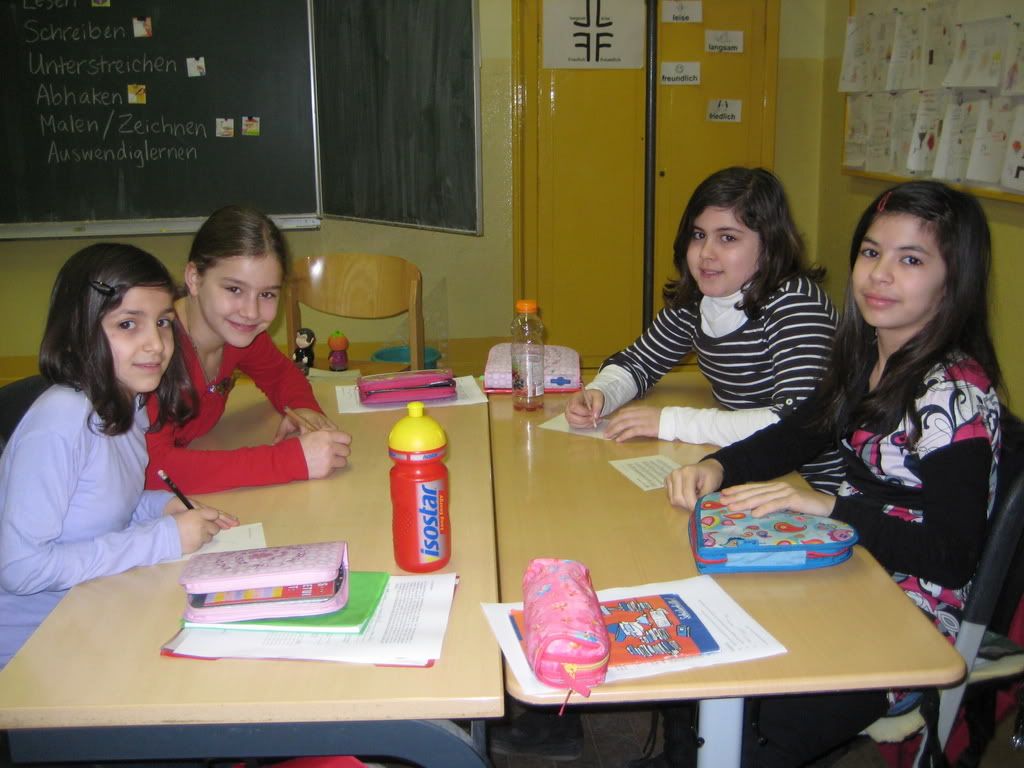
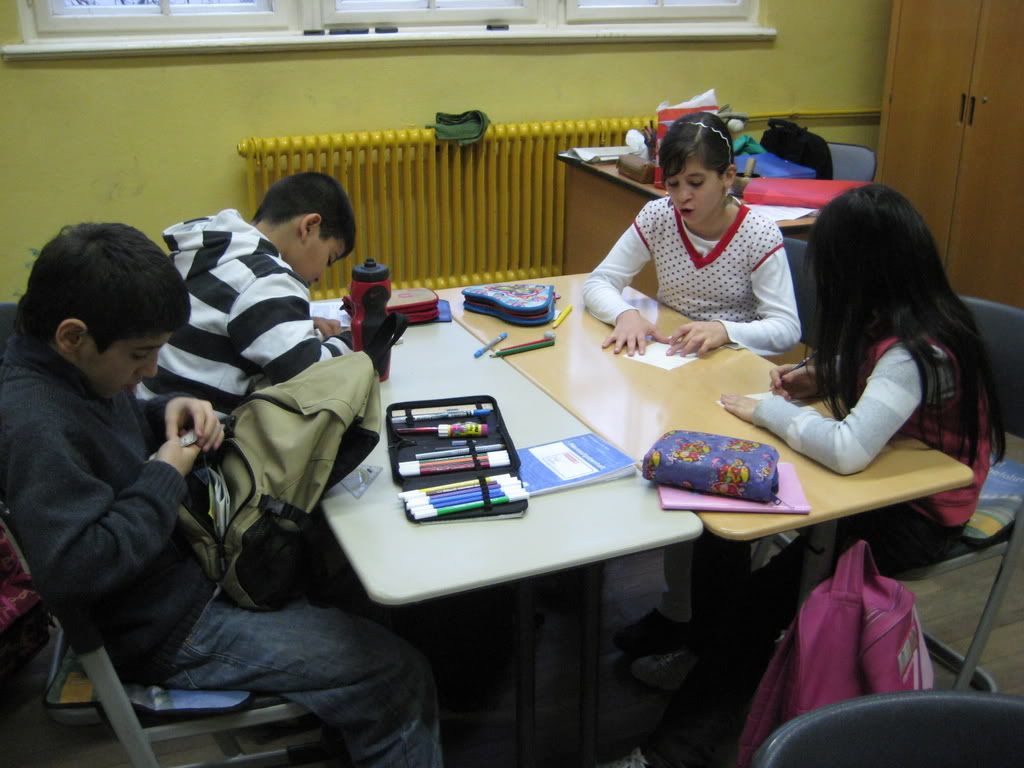
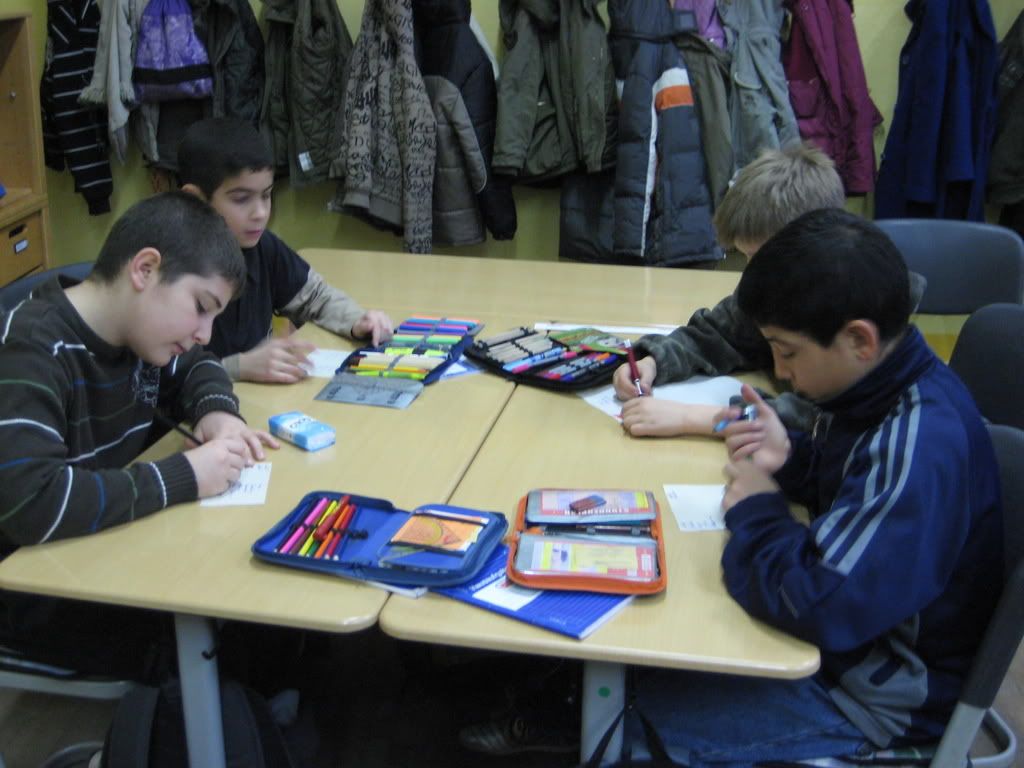
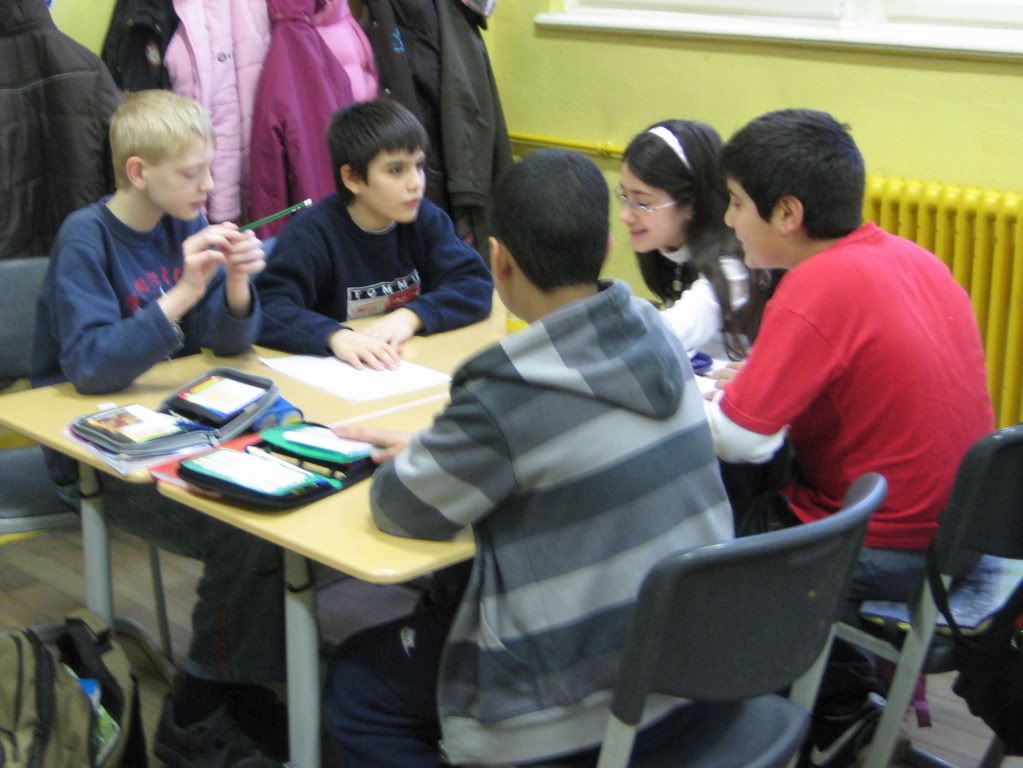
Last week at school we had a "project week," where the kids were with their homeroom teachers the first half of the day for a "project," instead of normal classes. This week it was all about "method training" for my 5th-graders - they did all kinds of exercises and activities to find out what type of learner they are, how to work in a group, how to give an oral presentation, etc. etc. On Friday, the parents were invited to come and here their kids give a presentation about what they had learned.


Friday was really really cool.


The kids were excited and nervous about their presentation. Almost all of them had a part (no one was forced to get up and talk), and they presented everything both in German and Turkish, since some of their parents don't speak much German. It was my first time to meet any of the parents, so I also introduced myself briefly - in German and in Turkish. The kids helped me figure out what to say and helped me practice, which was quite fun. Another teacher who is also Turkish helped me too during the break, and we spoke a little Turkish. (Hopefully this will continue in the future!) So I was a little excited and nervous too, like my kids.


Then the parents came. There were a few dads, but mostly it was moms. All with headscarves. I have to admit, it was a slightly intimidating moment when they all walked in the room. I had no idea what they thought of me and what kind of impression I would make on them. It is a strange feeling to find yourself in front of a group of people whose culture and beliefs are so different from yours, who would never dress like you're dressed, who probably assume the worst about you because of pop culture and the media...


And then it started, and I introduced myself in both languages... and the atmosphere softened a little. I didn't really take in their reaction to it, but Ulrike told me later that they suddenly seemed interested when I started speaking Turkish. I like to hope that somehow a door was opened that way.


Then the kids presented, and they did a great job. And inbetween one of my more difficult students occasionally looked over at his baby sister on his mother's lap and made silly faces with her, and I fell in love with them all. No matter how different we are - language, culture, dress, religion, everything - we all have something in common, we're all humans who laugh, cry, and love. I have loved these kids since my first day at E.-O.-Plauen, but in that moment, I fell in love with them more, and somewhere inside me a love for their families sparked too.


Afterward, as I was leaving the school, there was one place I had to go, even though I didn't know why. Around the corner from the school is this great little cafe owned by an incredibly friendly Turkish couple, and through my occasional visits I've gotten to know them a bit. I wasn't hungry and had already had too much coffee, but I had to go see them and share my joy for some reason. Taner, the husband, said, "You seem to really have fun doing what you do."

Yes! I absolutely do!


What a miracle it is to be exactly where I belong, exactly where my heart is calling me...